Work / Alf Studio
Planning software that learns from one teacher’s edits
A teacher fills in a short form, and Alf drafts a full project-based unit for any grade from Kindergarten to Grade 12. She can change any of it. It works the same way as my course agents: the AI drafts, the expert changes it, and the system keeps what they changed. I design Alf myself, and I build it by writing specs for AI coding agents and checking their work with tests and code review.
Alf was a finalist in MIT Solve: Accelerate STEAM Education, The 2025 GM Challenge. Watch the walkthrough or try it
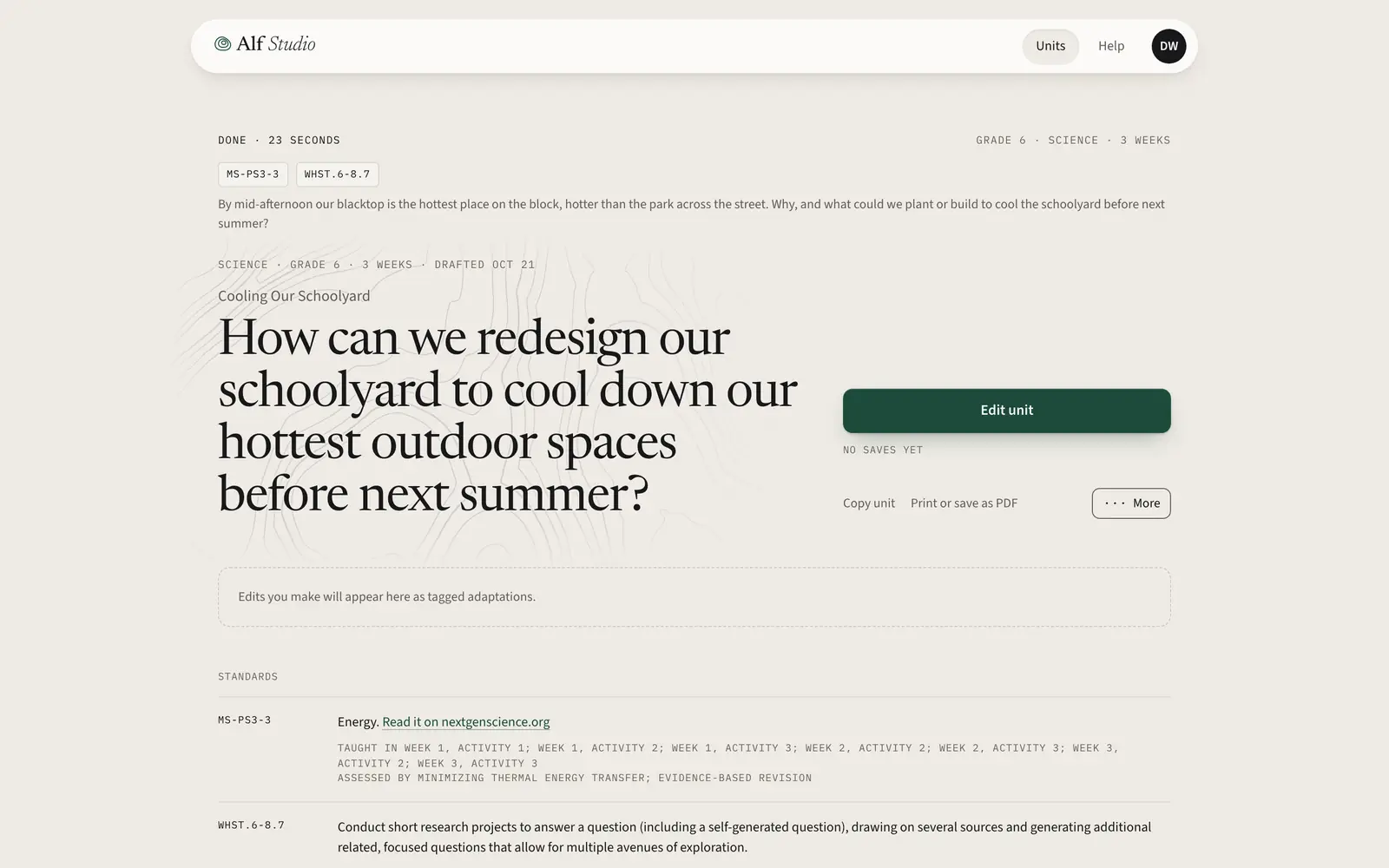
Done Alf’s own timer: 23 seconds
The product
Everything it drafts
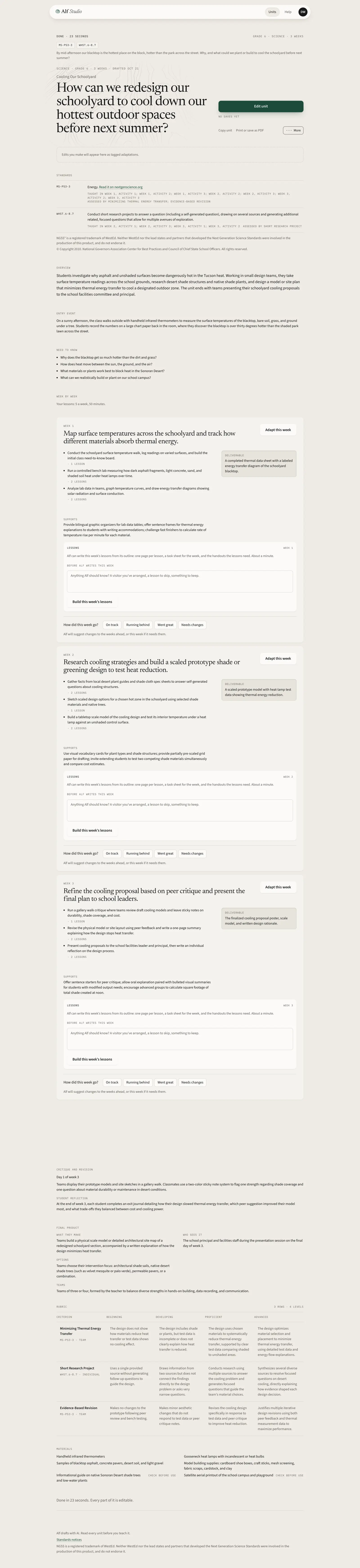
From one short form, Alf drafted everything below. Standards are suggested by matching her words, with no AI in that step, and she decides which ones stay.
How it learns
She decides what it learns
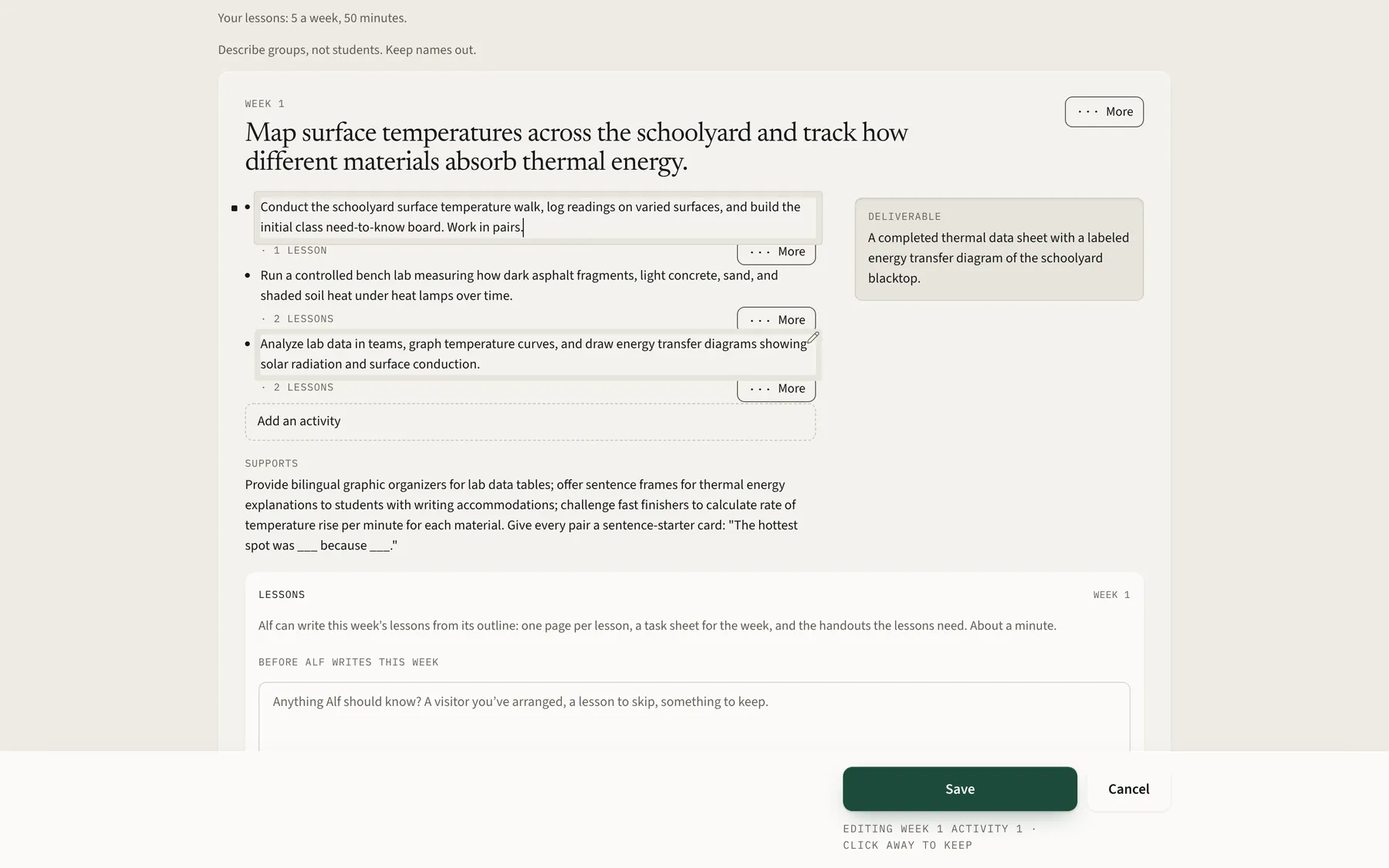
I made the teacher the reviewer in Alf, with the power to say no. Alf learns from her own edits and nothing else. It notices the changes she keeps making, but I limited it to four habits that can shape a draft: a tighter scope, sentence starters in week one, examples from her town and groups of three. She sees what it has learned, and none of it applies until she turns on the “Start my drafts this way” switch. It starts off. Alf never changes her words without her approval.
Walkthrough
The full walkthrough
Limits
What Alf will not do
Alf makes teachers six promises. I built each one into the code, so none of them rests on a policy alone.
| Alf will not | How the product enforces it |
|---|---|
| Collect student data | There is nowhere to put it: the database has no field for anything about a student. |
| Mistake its ideas for yours | Changes she keeps from Alf’s own suggestions never become habits that shape her drafts. |
| Make you chat | There is no chat screen. Every suggestion is a proposed change, checked against rules before she sees it, and thrown away whole if any check fails. |
| Lose your work | A saved version can’t be changed. Unsaved edits are backed up in her browser. |
| Hide its sources | Every standards set records its publisher, source, date and license, and a test fails if any notice is missing. |
| Keep your units from you | Print, copy into Google Docs or Word, or remove a unit at any time. |
Quality
How it is checked
Nothing Alf drafts reaches a teacher unchecked: every draft is checked against a fixed structure before she sees it. Before a change ships, I test it by hand: I run the same lessons through different AI setups and score each one against a written rubric. One test found 15 of 24 lesson builds failing; after the fixes it led to, 0 of 30 failed. Her name and email are never sent to the model. There are no student accounts or names, and no analytics or advertising.
The pattern
None of this is really about teachers
The people who know a place best are almost never the ones with time to change it. I sat with teachers before writing a line of Alf, and they asked two things: why would I use this and not a chatbot, and are you learning how I teach so you can replace me? The real problem was time and trust. The first version was a chat, and teachers gave up before they saw anything. The second was one short form and a draft in under a minute that she marks up, and the tool keeps what she changed. Most systems at that level are built to take the person out of the loop. This one was built to keep her in it.
The pattern holds anywhere a standard plan meets a real place. The AI drafts the generic version, the expert on the ground changes it, and the system keeps what they changed, so the next draft starts closer. The expert stays in charge. In October 2026 I gave a talk on it to 25 DC government leaders in the AI track of GW’s executive leadership program, and the second half of the session was the room mapping it onto their own agencies: disaster relief training, and the institutional knowledge that rarely gets written down. The conversation moved quickly from what AI can do to what it should be allowed to do, and who makes that decision.
Keep the expert in the loop
Will AI replace our experts? Before writing a line of Alf, I sat with teachers, and they asked me exactly that: are you learning how I teach so you can replace me? This loop is my answer.
Step 1
AI drafts the standard version
The generic draft, from what it was given and nothing else.
Step 2
The expert changes it
The person who knows the place keeps, edits or rejects the draft.
Step 3
The system keeps what they changed
Their edits become guidance for the next draft.
Step 4
The next draft starts closer
So the expert has less to change each time, and the loop runs again.
The expert stays in charge at every round.
Where I’ve built it
Course production, United Way Worldwide
Agents drafted each course from the subject expert’s meetings. Every review went into the agent’s instructions. Expert review time per course fell 78%, and the experts made fewer edits to each first draft.
Alf Studio
Alf drafts a unit; the teacher edits it in place. Alf notices the changes she keeps making, and none of it applies until she turns on “Start my drafts this way.”
Where else it fits: anywhere a standard plan meets a real place. Dispatch routes, inspection checklists, outreach plans, any operating procedure.
Dispatch
The AI drafts the standard route for a request type. The dispatcher who knows which block floods every time it rains changes it, and her reroutes are kept.
Inspection
The AI drafts the checklist for a building type. The inspector who knows what that landlord hides adds to it, and what she adds is kept, with why.
Outreach
The AI drafts the campaign plan for a district. The community worker who knows which door to knock on first changes it, and the local knowledge that usually leaves when she does, stays.
Any operating procedure
The AI drafts the standard. The person who has been there twenty years changes it. The question for every organization: who is that person, and how do you design so they stay in charge?
Origin
From framework to product
NuVuX
Active Learning FrameworkIts four parts are Catalyst, Issue, Method and Engagement. I co-developed it with Nakeia Medcalf and Amanda O’Keefe, and it was delivered virtually to leaders in Cameroon and Nigeria.
2023
AI co-design toolsI built prompt packs and exemplars that drafted project briefs and rubrics for educators. People checked the drafts.
2023 to 2024
Two custom AI assistantsOne, AL, turns the framework into project-based curricula. The other, Di, guides teams through design thinking.
2025
Alf CoachAlf Studio followed in 2026.
2026
Alf StudioA teacher’s short form becomes a full unit she can edit.
Related
- AI course productionThe same idea at work: the expert stays in charge
- Four questionsThe questions to answer before you put AI to work